Showing posts with label places to visit. Show all posts

Tuesday, 22 February 2011

Amazing Petra - A visit to Little Petra

Located out of town, away from the main site of Petra, is Little Petra, also known as Al-Beidha - a much smaller version of the famous Nabateaen city. There is no entrance fee, which is nice compared to the 50JD asked, but you can't really compared the sites either. However for those who cannot afford the above price it is a nice little compromise to get the feel of Petra.

Entrance to Little Petra

Basically the site is a small siq (natural cleft in the rock) - with a complex of cisterns, dams and dining halls located in 3 small natural courtyards. The interesting thing is that there are barely any tourists and it is possible to walk in and out of the halls as you wish.


The site was a halting station and also one of the main commercial areas of Petra, passage point for the caravans on the trade route to the north and north-west. The traders would stop here and settle so they could engage in trade.

Here are a couple of  links to web-sites:
http://nabataea.net/beidha.html
http://www.grandview.com.jo/little_petra.html - I like this one a lot - it is extracts from a book, called "Petra Book", by Jane Taylor.

Thursday, 17 February 2011

Visit to Umm Qais

I have been away from my blog for ages, and I am so happy that I can finally sit down and write again! There are always lots of reasons why one can't blog, but my main reason (a part from having visitors for quite some time) is that Bibs kind of took over my laptop when the tv suddenly went funny. The only time during the day I can write is when she quietly sits and watches her favourite program "Peppa Pig". So you got it, TV is working again: Bibs can have her screen and I can have mine.

Have so much to tell as we have done quite a few things in the last month; and I have decided to start with the last thing we did: a visit to Umm Qais.


Umm Qais is located in the North Westerly corner of Jordan, just at the border with Israel and Syria; the site overlooks Lake Tiberias, aka Sea of Galilee, the Golan Heights and the Jordan Valley. It was a member of the Decapolis (during the Roman Empire) and was then known as Gadara. The city was then a cultural centre and was home to many poets and philosophers.

I found the site very beautiful, specially because it is so green there. Unfortunately it takes nearly 2 hours to get there from Amman - the drive goes through Irbid, the second largest city in Jordan and that means that you waste a lot of time.

Entrance to the site
It is fairly easy to get to Umm Qais, there are signs the whole way (this is worth mentioning as: 1. it is very rare in Jordan - 2. it is not the case when you need to go back to Amman!). The entrance is free for the residents and tourists need to pay 3JD.

View of the theatre
The theatre was built in the 2nd century AD against the western slope of the Acropolis. It could host around 3000 visitors and is built entirely in basalt. It was destroyed by an earthquake in the 8th century.
There are many things to look at on the site:
The main road in Gadara
The Nymphaeum
Archaeological museum (closed on Tuesday) 
The site is also known for a biblical event: this is thought to be the place where Jesus cast devils into swine, which then drowned in the waters of Lake Tiberias.

View of the Lake Tiberias or Sea of Galilee (and the Nymphaeum)
If you schedule your visit over lunch I have heard that the guesthouse, located just across the road from the entrance should be rather good - not a bad idea before a long drive back. The views are surely stunning. 

Jordan Valley
The other attraction of the area is Al-Himma - therapeutical hot springs located about 10 kilometres north of Umm Qais, they were already in use by the Romans, whom apparently regarded them highly. Today there are both a privately run bath and a public one (with separate timetables for men and women).

As I have already said it is a bit far away, which is unfortunate because I don't think I will go again. It is the kind of place you visit once. Yes, the views are amazing, the biblical reference interesting, but it is just too far from Amman. I wouldn't recommend to go to Jerash and then Umm Qais, I think it is too much to do in one day. One last thing it is not a stroller friendly site!

Here is a link to more pictures.

Sunday, 16 January 2011

Visit to Umm Ar-Rasas

I have been quiet this last month but it doesn't mean that I haven't been doing stuff. Still so much to see in Jordan. I started off the new year with a visit to Umm Ar-Rasas (also known as Um Er-Rasas, Kastrom Mefa'a). The site is located 30 kilometres south-east of Madaba and it makes it a perfect afternoon trip from Amman. We had lunch at Haret Jdoudna in Madaba and then continued to Umm Ar-Rasas. I wrote about that restaurant a year ago, after our first visit to Madaba, and their website was under construction... well it still is! But the food is still great, their hummus is yummy, my favourite is their lamb sausages in a tomato sauce, delicious.


Umm Ar-Rasas has been a world heritage site since 2004 - it started as a Roman garnisson, became a town in the 5th century. Most of the site has not (yet?) been excavated - the highlight is definitely one of the 16 discovered churches: Saint Stephens Church (AD 785) with its very well preserved mosaics.

St Stephens Church
It is easy to see that it was a big church, with several chapels. As I said the mosaics are very well preserved: the ones on the right underneath show the cities of the region (Palestine, Jordan or Egypt) written in Greek script.

In the top right corner, you can see an Icon, the only one there I believe


This section shows: Kastrom Mefa'a, Philadelphia (Amman) and Madaba.

Underneath a couple of pictures from the Church of the Lions - called so because of the mosaics found. It is not possible to see the mosaics as they are covered by plastic and sand for protection. I can only guess that this is a temporary solution until a more suitable one is found.


Like all sites in Jordan, there wasn't much information available, so do some research before you go if you want to enjoy it fully. There is a visitor centre but apart from the tourist police, everything was closed. We didn't pay an entrance fee, but had the pleasure of a escort by one of the police officers, who didn't speak much English, we still gave him a tip at the end of the tour. If you have a stroller it is possible to walk around with it on the major track. 

Some more pictures...


Saturday, 27 November 2010

Back in Amman 2: Karak Castle

To get to Karak you can take the Dead sea highway or the King's highway (through Wadi Mujib) where the scenery is much more exciting, but it would be a bit too long for Bibs - she tends to get very bored in the car. So we took the Desert highway, the fastest way to get there. We managed to find Karak and the castle without getting lost, not thanks to the signs though...

a sign, with some remains from the elections
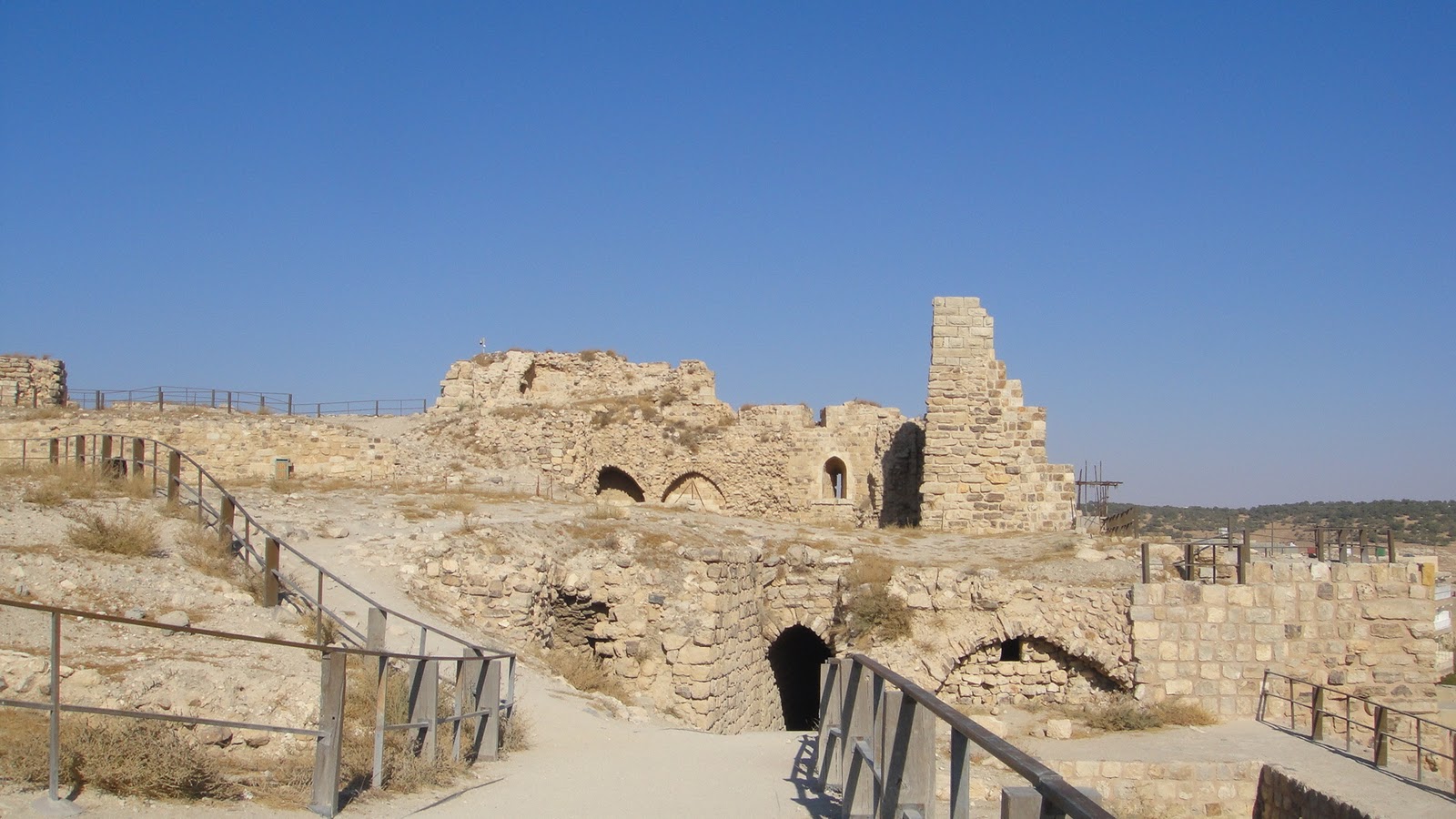
view of the castle
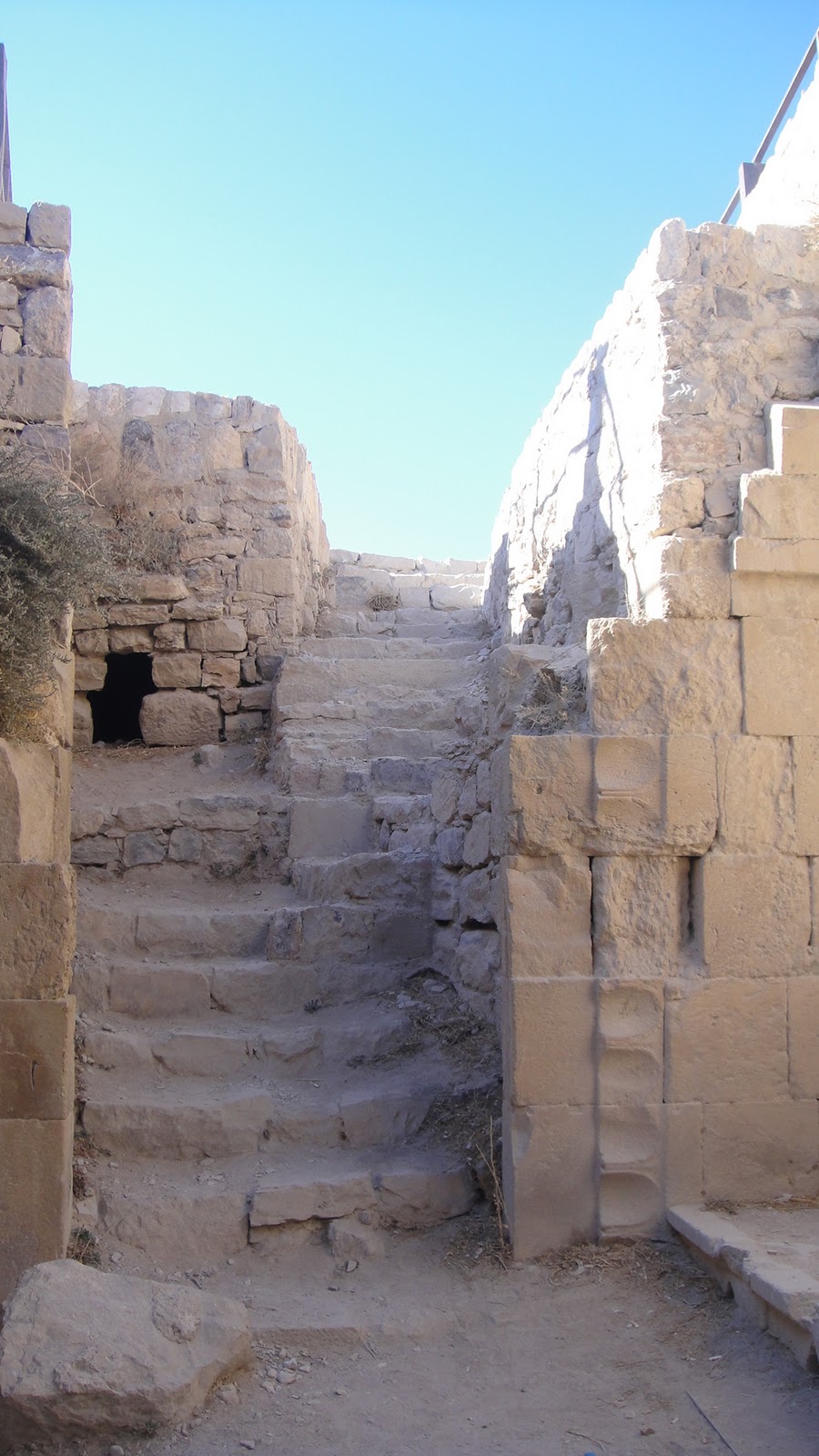
The castle, probably the largest in Jordan, from the Crusaders' time, was built in 20 years and finished in 1161, when it became the residence of the lord of Transjordan (the most important fief of the Crusader kingdom, as it was rich in both produce and tax revenues). But long before the crusaders arrived in the region (some 29 centuries ago), the fortress of Kir Heres (or Kir-Haresesth) is mentionned several times in the Bible, like in the Book of Kings (2 King 3:25): "In the end, there was only Kir-hareseth left, which the slingers surrounded and battled." - a descritpion of the Israelites assaulting Moab and taking the fortress. There is also another version of this event: which is the famous Mesha Stele or Moabite Stone. The site being this old came obviously also in the hands of the Nabateans (the ones from Petra). There is one small remain from the 2nd century AD.


Nabataean Relief
It is the bust of a man - unfortunately he has lost his head, but it has been identified as a funerary monument of a Nabataean cavalryman. 


View towards the Dead Sea and Israel
View South towards the Lower Court
The views are spectacular. It is said that on a clear day you can see as far as the Mount of Olives in Jerusalem. 

There is a small museum presenting findings from Karak and the Moab region.

Entrance to the Museum (lower court)


There is a small leaflet availbale at the visitor's center. It is well made with lots of information. The trouble is only that it is not that easy to know exactly where you are in the castle, so it is good to have the leaflet at all times and follow the small plan. A guide kind of just took us along (we paid him 2jd) and he showed us some of the things. It is also possible to rent audio equipment for 5jd. Depending on how much you want to know about the site. As usual I feel that I don't know enough, so when my parents come next year I'll probably go back for a second round.

The castle is built in 2 levels (upper court and lower court), as can be seen clearly on the pictures beneath. There are 2 main periods: the Crusaders, late 12 century and the Mamluk, 13th to 15th century. 

Crusader Galleries

Upper court - inside view of the Crusader Gate 


You can walk around completely freely in the castle. There are a few signs along the way, but there are places where we wouldn't have gone without the guide, like the prison or the dormitories. The entry to the castle is 1JD for tourists and 150fils for residents. It is not a stroller friendly site, there are steps everywhere. Bibs enjoyed walking around, picking up stones and being carried a little bit as well, when down in the prison cells. There are no lights whatsoever in the underground vaults, only small openings here and there in the ceiling or the walls so the guide was walking around with a flash-light.

The castle is a must visit in Jordan. Then there is also the city of Karak. It used to be completely fortified and there are still towers and hidden entrances to the castle around the city. There are plenty places to eat and drink around the castle should it be lunch time.

Sunday, 26 September 2010

National Gallery of Fine Arts

This has been on my to-do-list for a little while, and yesterday I finally made it: to the Jordan National Gallery of Fine Arts.


The gallery is located in 2 different buildings, on each side of a small park and houses a permanent collection of contemporary art from Jordan, the Arab world and other developing countries, mainly Africa and Asia.


Building number 1 as it is called, the one with the terrace on the top on the picture, is definitely the most interesting out of the 2. It is much bigger and the collection, I found, easier to understand and more approachable. I thought this one was impressive: it is views of street walls in Palestine.


On the 2nd floor there is a small library, specialised in arts of course. They have a small selection is Arabic, English and French.


There is also a small cafe, unfortunately closed when we were there. And then a small terrace with an amazing view over Amman and the Blue Mosque.


I found this picture very interesting. You can see the King Abdullah Mosque, aka the Blue Mosque, recognisable with its blue dome. It was built as memorial to the late King Hussein's grandfather. It is possible to visit it, so I really want to go. Just in front there is a church, other mosques around and then of course the building sites, squattered across Amman.

In the second building there is a small souk Zara outlet. It is handcrafts type of shop which can also be found mainly in hotels in Amman (Grand Hyatt, Intercontinental) but also in other hotels across the kingdom (Dead Sea, Petra, Aqaba). They offer jewelry, ceramics, postcards, woodwork, mosaics... Unfortunately it was closed in the middle of the afternoon... The entrance is 5JD per person (we didn't pay for my friend's daughter who is 10).

We had a nice afternoon. It is a small but interesting museum. There is access to strollers, wheelchairs... A good point as it is rare in this country.

There is also a nice garden and a cafe, will talk about that in a separate post. I took also plenty of pictures of the area, because the architecture is very different to the part of Amman where we live. All to come...

Saturday, 3 July 2010

Souk Jara - a lovely outdoor market in Amman

In 2004, in order to maintain and preserve the identity of the Jabal Amman area the residents created an association named JARA (Jabla Amman Residence Association). It is a very attractive area, lovely to walk around in, lots of old houses to look at.

During the summer months, on fridays, there is a small outdoor flea market called Souk Jara which has been organised. It is located off Rainbow Street, next to the Jordan River Foundation. I think I remember that I have read somewhere that the market is open from 9am to 9pm.

The entrance to Souk Jara

Views of the Market

We went just before lunch and there wasn't that many people, it was still possible to walk around with Bibs in her stroller. There are 40 so stalls selling everything from hand made jewelry, honey, frames, handcrafts. The girl with the soaps, that I met at the Farmer's market is there as well. She told me that in the evenings there are concerts as well. I guess the crowd is a bit different then. There is a playground for kids and a small alley with lots of food stalls as well.

Food stalls - very busy!

If you are in Amman on a Friday during the summer months, it is definetely worth a visit. I really liked it. I think I will be going back next week and browse for a couple of gifts to bring with me when we are going back to Europe.

A little bit before the market on the opposite side of the street, there is a small shop selling handcrafts. There are some really lovely things - a bit expensive though.


As usual I am updating my map, you can find a link to it at the bottom of the page.

Others To Read:

Related Posts with Thumbnails