Showing posts with label museum. Show all posts

Saturday, 27 November 2010

Back in Amman 2: Karak Castle

To get to Karak you can take the Dead sea highway or the King's highway (through Wadi Mujib) where the scenery is much more exciting, but it would be a bit too long for Bibs - she tends to get very bored in the car. So we took the Desert highway, the fastest way to get there. We managed to find Karak and the castle without getting lost, not thanks to the signs though...

a sign, with some remains from the elections
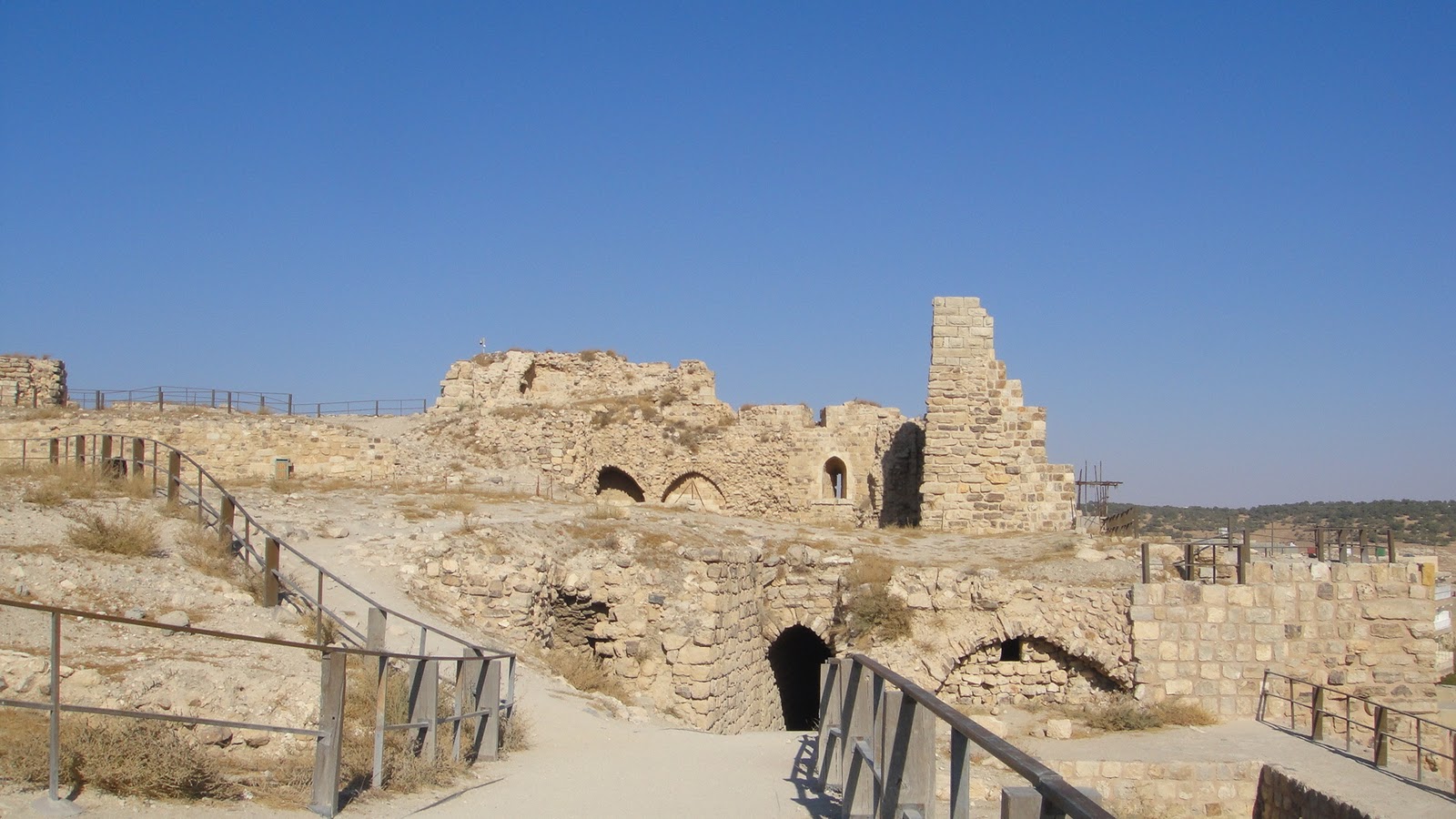
view of the castle
The castle, probably the largest in Jordan, from the Crusaders' time, was built in 20 years and finished in 1161, when it became the residence of the lord of Transjordan (the most important fief of the Crusader kingdom, as it was rich in both produce and tax revenues). But long before the crusaders arrived in the region (some 29 centuries ago), the fortress of Kir Heres (or Kir-Haresesth) is mentionned several times in the Bible, like in the Book of Kings (2 King 3:25): "In the end, there was only Kir-hareseth left, which the slingers surrounded and battled." - a descritpion of the Israelites assaulting Moab and taking the fortress. There is also another version of this event: which is the famous Mesha Stele or Moabite Stone. The site being this old came obviously also in the hands of the Nabateans (the ones from Petra). There is one small remain from the 2nd century AD.


Nabataean Relief
It is the bust of a man - unfortunately he has lost his head, but it has been identified as a funerary monument of a Nabataean cavalryman. 


View towards the Dead Sea and Israel
View South towards the Lower Court
The views are spectacular. It is said that on a clear day you can see as far as the Mount of Olives in Jerusalem. 

There is a small museum presenting findings from Karak and the Moab region.

Entrance to the Museum (lower court)


There is a small leaflet availbale at the visitor's center. It is well made with lots of information. The trouble is only that it is not that easy to know exactly where you are in the castle, so it is good to have the leaflet at all times and follow the small plan. A guide kind of just took us along (we paid him 2jd) and he showed us some of the things. It is also possible to rent audio equipment for 5jd. Depending on how much you want to know about the site. As usual I feel that I don't know enough, so when my parents come next year I'll probably go back for a second round.

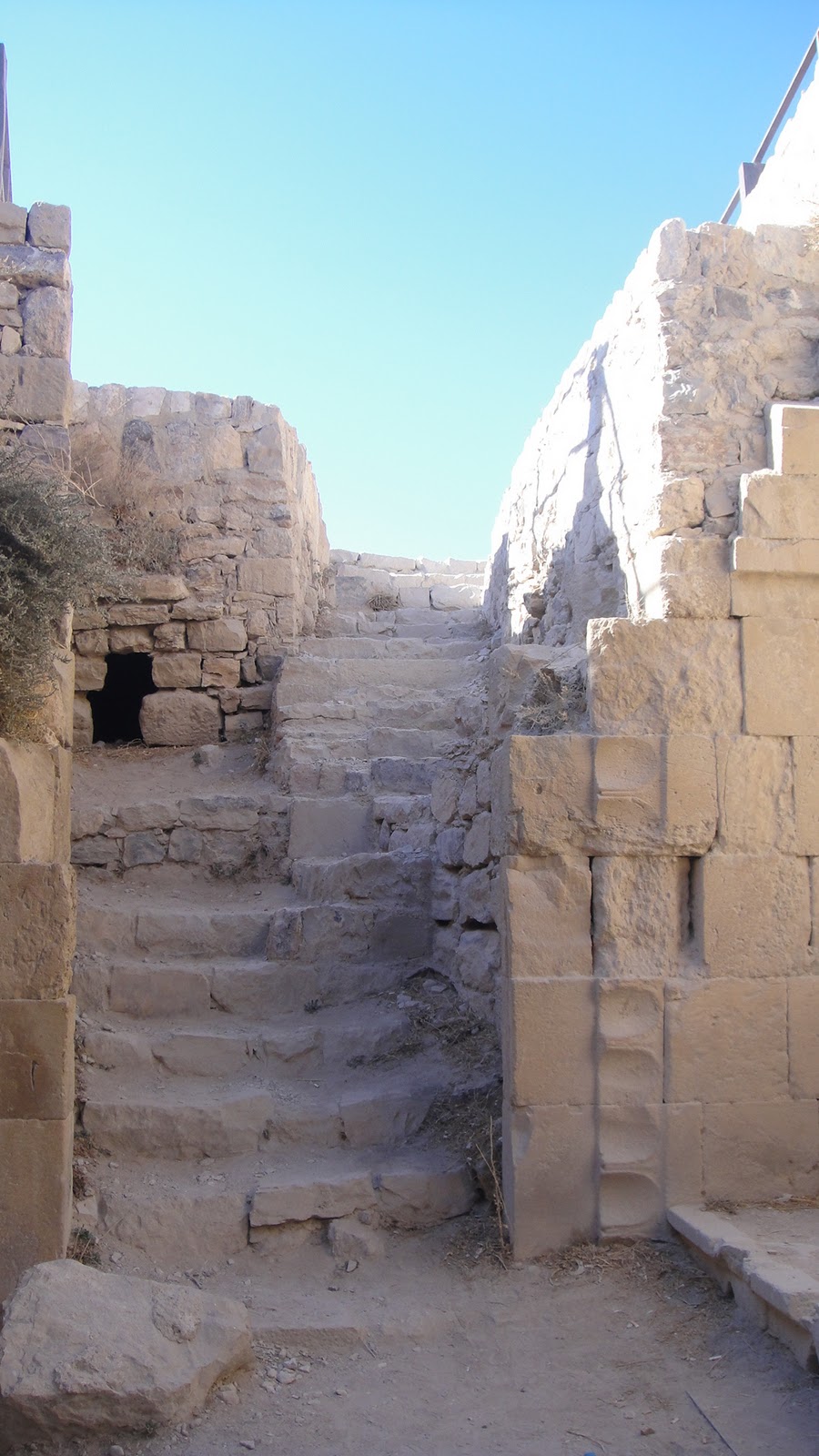
The castle is built in 2 levels (upper court and lower court), as can be seen clearly on the pictures beneath. There are 2 main periods: the Crusaders, late 12 century and the Mamluk, 13th to 15th century. 

Crusader Galleries

Upper court - inside view of the Crusader Gate 


You can walk around completely freely in the castle. There are a few signs along the way, but there are places where we wouldn't have gone without the guide, like the prison or the dormitories. The entry to the castle is 1JD for tourists and 150fils for residents. It is not a stroller friendly site, there are steps everywhere. Bibs enjoyed walking around, picking up stones and being carried a little bit as well, when down in the prison cells. There are no lights whatsoever in the underground vaults, only small openings here and there in the ceiling or the walls so the guide was walking around with a flash-light.

The castle is a must visit in Jordan. Then there is also the city of Karak. It used to be completely fortified and there are still towers and hidden entrances to the castle around the city. There are plenty places to eat and drink around the castle should it be lunch time.

Tuesday, 28 September 2010

Visit to Canvas and the National Gallery park

The gallery's two buildings are surrounding a small sculpture park and Canvas, a restaurant/coffee shop. The coffee shop is nice, will have to go back for lunch. We just had a cup of coffee and my friend's daughter a big chocolate sunday. Well to be exact we ordered a ice coffee, but first then came with a ice tea which we sent back and then they came a ice coffee without coffee. There was ice cream, chocolate, milk and cream. We kept it that way! But it is a nice place to stop after the museum visit.


There are some paintings exposed inside and a very nice terrace outside overlooking the small park.

We then for a small walk in the park. It is water conservation project developed with governmental and local support as well as USAID. It is a sculpture park, there is a children's playground and is a very pleasant place to walk with a stroller, kids can play, young people meet on dates.


Sunday, 26 September 2010

National Gallery of Fine Arts

This has been on my to-do-list for a little while, and yesterday I finally made it: to the Jordan National Gallery of Fine Arts.


The gallery is located in 2 different buildings, on each side of a small park and houses a permanent collection of contemporary art from Jordan, the Arab world and other developing countries, mainly Africa and Asia.


Building number 1 as it is called, the one with the terrace on the top on the picture, is definitely the most interesting out of the 2. It is much bigger and the collection, I found, easier to understand and more approachable. I thought this one was impressive: it is views of street walls in Palestine.


On the 2nd floor there is a small library, specialised in arts of course. They have a small selection is Arabic, English and French.


There is also a small cafe, unfortunately closed when we were there. And then a small terrace with an amazing view over Amman and the Blue Mosque.


I found this picture very interesting. You can see the King Abdullah Mosque, aka the Blue Mosque, recognisable with its blue dome. It was built as memorial to the late King Hussein's grandfather. It is possible to visit it, so I really want to go. Just in front there is a church, other mosques around and then of course the building sites, squattered across Amman.

In the second building there is a small souk Zara outlet. It is handcrafts type of shop which can also be found mainly in hotels in Amman (Grand Hyatt, Intercontinental) but also in other hotels across the kingdom (Dead Sea, Petra, Aqaba). They offer jewelry, ceramics, postcards, woodwork, mosaics... Unfortunately it was closed in the middle of the afternoon... The entrance is 5JD per person (we didn't pay for my friend's daughter who is 10).

We had a nice afternoon. It is a small but interesting museum. There is access to strollers, wheelchairs... A good point as it is rare in this country.

There is also a nice garden and a cafe, will talk about that in a separate post. I took also plenty of pictures of the area, because the architecture is very different to the part of Amman where we live. All to come...

Wednesday, 19 May 2010

Archaeological Museum in Amman


Located on the site of our famous citadel, there is a small but well appointed archaeological museum.
The collection ranges from the Paleolithic era to the islamic era (so covering several hundred thousand years). The museum displays artifacts found in all the archaeological sites around Jordan, you can see items of daily life such as pottery, tools, but also statues, coins...

One of the most important exhibits are these plaster statues from "Ain Ghazal". They date back from the pre-pottery Neolothic era, around 6000 BC.

They look a bit extraterrestrial to me!

They were discovered in a cache at a site, located on the outskirts of Amman in 1983 and then some more in 1985. The statues are made of plaster applied to an interior reed armature. They are thought to be funeral statues and could commemorate deceased family members in more important families. The statues were found buried underneath the floors of uninhabited houses. The theory is that these statues were made for ancestor worship and when no longer needed, they were then "buried".

Another very interesting thing to see is the exhibit of the Dead Sea Scrolls.

Discovered at Quram, Israel in 1947

In spring 1947, a bedouin discovered jars containing scrolls in the caves facing Qumran. The scrolls make up a veritable library, with a time span ranging 2 centuries BC. The texts are written in Hebrew, Greek and Aramaic. All the books from the old testament are included. Many documents concerning the activities of the Essene (a Jewish sect) were also found.

A copy of the Mesha Stele (aka Moabite Stone) is also on display at the Museum. The original one can be found at the Louvre in Paris, France. The Stele was discovered in Dhiban (ancient Dibon) in 1868. This stone constitutes a direct account of the history of the world that is related to the Bible.

Mesha Stele in the Louvre

Some more interesting things on display at the Museum

To the left: some very rare sarcophagi dating from the Iron Age. To the right: marble head of the goddess Tyche, daughter of Zeus. Goddess of fortune and protectrice of Amman. It was found in the Garden of the Museum in 1957.

A little note: the first time we went to the Citadel, we didn't pay an entrance fee, but this time we did. 150fils for residents and 2JD for the non-resident.

Monday, 12 April 2010

A couple of Museums in Amman

Located at the Amphitheater in downtown Amman are 2 small museums: the Jordan Folklore Museum and the Museum of Popular traditions. The museums are small but interesting.

At the right end of the amphitheater you can find the Folklore Museum. This one displays a collection of items showing the traditional Jordanian way of life, including home furnishings, musical instruments and handicrafts.

This represents a typical village home
Top right hand corner: a woman doing embroidery. This was done on folk costume, headdresses and veils, usually in geometric designs. To the left: a woman using a Rahhah, commonly utilised for grinding wheat. 

These are different looms: one for waving straw mats, the vertical one was used by villagers to wave tents from goats hair and the horizontal loom was used to make hair rugs for camels, called "figeh".

"Beit Shaar"

The tents where the Bedouins live are called "Beit Shaar". These ae weaved with goat hair and is completely waterproof. The tents are divided into 2 living areas: "el Muhram" for the women and "el Shigg" for men. To the left hand of the picture there is a man grinding coffee. The instrument is called a "Mihbash" - it is used to ground the coffee after it is roasted, in the process the grinder is making rhythmic musical sounds, accompanied by singing - so the "Mihbash" is also considered a musical instrument.


At the other end of the amphitheater stage is located the second museum: Popular traditions. This museum displays the traditional costumes of Jordan's people. One of the things displayed here are embroideries and dresses. They are really beautiful and differ from town to town.


In the basement, you can find a collection of mosaics from Madaba and other Byzantine Churches in Jordan.


Others To Read:

Related Posts with Thumbnails